
 Nermin Sad · CEO & Co-founder
Your margins are telling a story your revenue can’t. Pricing intelligence helps you find the leaks before they become losses.
Imagine discovering that your best-selling product has been losing profitability for weeks — not because demand disappeared, not because your ads stopped working, but because the market moved while your pricing stayed still.
Orders kept coming in. Revenue kept climbing. The business looked healthy.
Until the margin told a different story.
That is the uncomfortable truth many e-commerce merchants discover too late: pricing problems rarely announce themselves as obvious failures. They hide inside growth, quietly reducing profitability while everything else appears to be working.
We have had versions of this conversation with a lot of merchants.
And almost every time, the answer ends up being the same place nobody thought to look first:
Pricing.
‘Revenue hides pricing mistakes. Margins expose them.’
The most strategic decision in your business is also the most neglected
Pricing touches everything: margin, positioning, promotions, cost pressure, and whether growth actually becomes profit.
And yet, for most e-commerce businesses, pricing operates on autopilot.
A number gets set when a product launches. It gets adjusted when a competitor makes an obvious move, or when a sale needs a discount, or when someone notices a product has stopped selling. In between those moments — which can stretch into months — the market moves without you.
‘Most businesses don’t have a pricing strategy. They have a pricing history.’
Competitors reprice. Consumer demand shifts. Inventory dynamics change. Advertising costs fluctuate. The conditions that made your price correct on the day you set it are rarely the same conditions that exist three months later.
But the price stays the same.
‘The market changes daily. Most pricing systems don’t.’
That gap — between where your pricing is and where it should be is where margin goes to die.
Reactive pricing is not a strategy. It’s a liability.
Here is what reactive pricing actually looks like in practice.
A competitor quietly drops their price by 9% on a Tuesday. You don’t notice for two and a half weeks. In that window, your conversion rate on that product slips. Not dramatically — just enough. You run a report, see the dip, assume it’s seasonal, move on.
A product that used to anchor your store starts underperforming. You discount it. Sales recover briefly. You call it solved. Three months later the same product is underperforming again, and you discount it again, and the cycle repeats each time compressing the margin a little further.
None of these moments looks catastrophic in isolation. But across dozens of SKUs and months of market movement, they compound — until growth no longer translates into the profitability it should.
This is the pricing problem. It isn’t loud. It isn’t sudden. It’s the slow accumulation of decisions made without the right information or decisions deferred until it’s already too late to make them well.
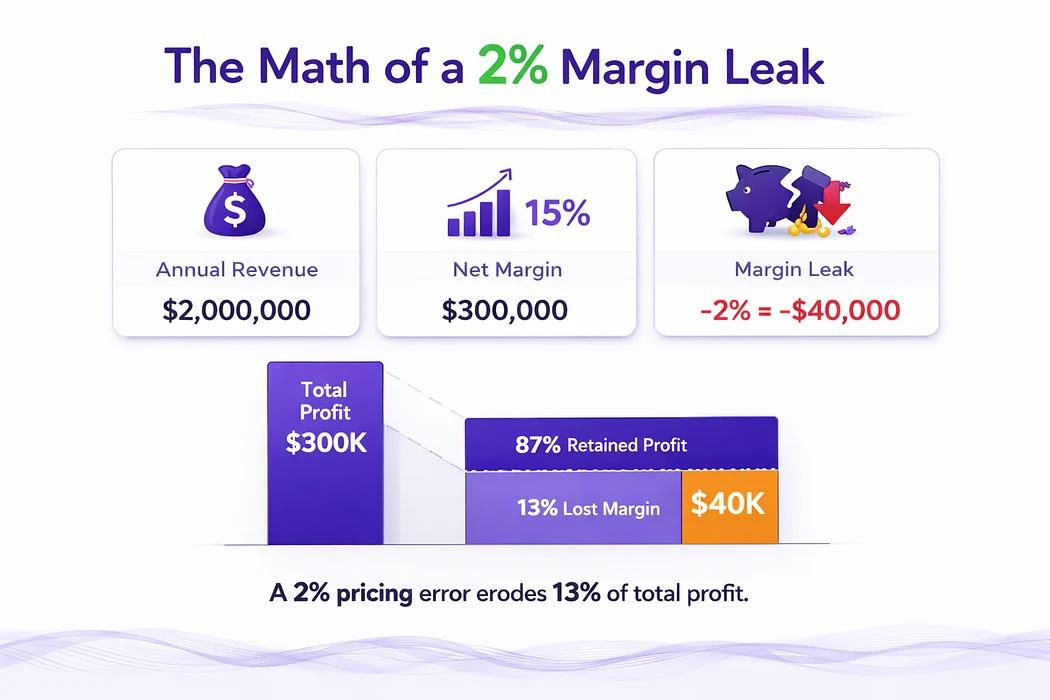
The Math of a 2% Leak
If your store generates $2M in annual revenue with a 15% net margin, your annual profit is $300,000. A 2% pricing leak across the catalog equals $40,000 — more than 13% of total profit.
That is not a small pricing mistake. That is a meaningful profit leak hiding inside revenue growth.
Revenue is vanity; margin is sanity.
Your revenue isn’t the problem — your pricing blind spots are.
The tools most merchants use weren’t built for this
Spreadsheets were built for record-keeping, not decision-making at speed.
Manual competitor monitoring works for spot-checks, not for tracking dozens of competitors across hundreds of SKUs.
Rules-based automation sounds smart until it triggers a race to the bottom and automates you into lower margins.
The gap in the market isn’t a lack of data. Most merchants have more data than they know what to do with. The gap is the layer between data and decision; the intelligence that turns fragmented signals into a clear, structured understanding of what’s happening in your market and what the right move is.
For Shopify merchants, the challenge is no longer just tracking competitor prices; it is building an e-commerce pricing strategy that protects margins while supporting growth.
That’s the gap we built Pricenaux to close.
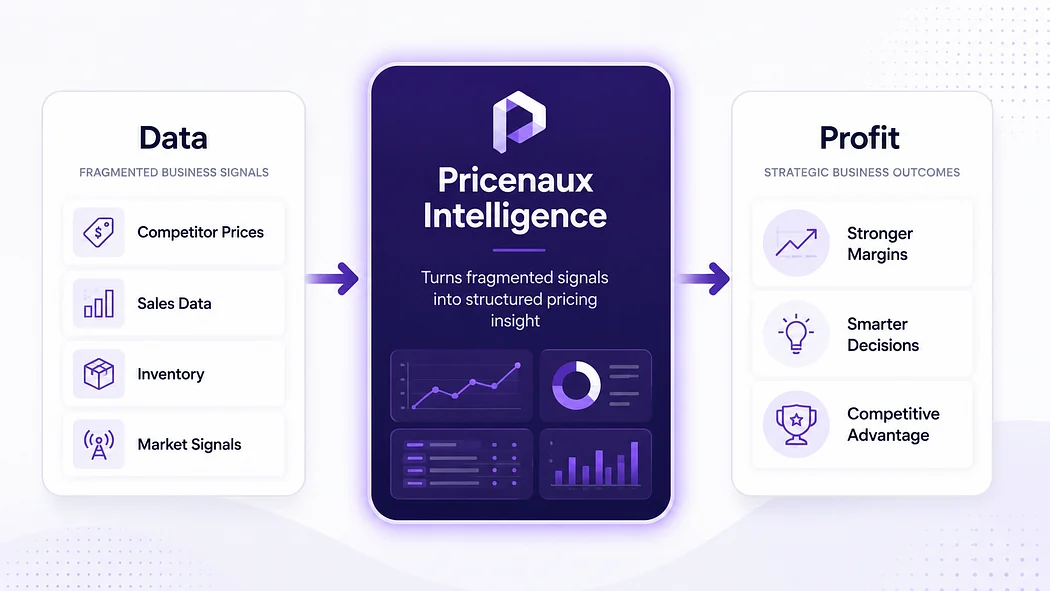
Pricenaux turns competitor prices, sales data, inventory, and market signals into clearer pricing decisions.
Pricing intelligence, not just pricing automation
We want to be precise about what we mean when we say intelligence, because the word gets used loosely.
Automation executes rules. Intelligence informs decisions.
An automated system will match a competitor’s price drop because a rule told it to. An intelligent system will surface the competitor’s move, show you what it means for your margin, tell you which customer segments it’s likely to affect, and help you decide whether to match, hold, or respond differently based on your actual business context, not a generic rule.
The difference matters because pricing decisions are not all the same. A flagship product with strong brand attachment should not be treated like a commodity SKU in a crowded category.
What merchants need isn’t faster automation. It’s clearer thinking. A system that makes the complexity of the market legible, and turns that clarity into decisions they can act on with confidence.
That is what we are building.
Why this, why now
During years of working with startups and evaluating hundreds of business models, one pattern kept appearing.
Teams could explain their product, market, growth strategy, and customer acquisition plan in detail. But when the conversation turned to pricing, the answers often became less certain.
Pricing was treated like a number to set, not a strategic function to manage.
That disconnect became impossible to ignore. Because pricing is not a detail inside the business model. Pricing is where the business model proves itself.
The economics of e-commerce have shifted from a game of volume to a game of precision. With customer acquisition costs reportedly rising, advertising efficiency under pressure, and margins harder to protect, businesses can no longer grow their way out of weak unit economics.
In this environment, pricing isn’t a nice-to-have optimization; it’s a survival capability. The businesses that will build durable, profitable operations in the next five years are the ones that treat pricing as a strategic function — something that’s actively managed, informed by changing signals, and systematically improved.
We believe pricing intelligence will become foundational infrastructure for modern commerce. Not because it’s a trend, but because the alternative is operating in increasingly competitive, data-rich markets with outdated pricing tools is becoming untenable.
We started with Shopify merchants because that’s where we saw the problem most acutely, and expanded support as Pricenaux evolved across Amazon and Walmart workflows.
This is where we start
This blog is where we’ll think out loud about pricing: what’s working, what isn’t, what we’re learning from merchants, and where commerce is going next.
If you’re an e-commerce operator tired of treating pricing like a guessing game, Pricenaux is free to start — no credit card required.
Pricing should be a competitive advantage — not a guessing game.
Pricenaux is an AI-powered pricing intelligence platform for e-commerce and retail. We help modern commerce businesses move from reactive pricing to intelligent, margin-protecting decisions across Shopify, Amazon, and Walmart workflows.
Have a perspective on this topic?
Continue the discussion with Pricenaux and other operators on LinkedIn.
Join the LinkedIn DiscussionHow mature is your pricing process?
Benchmark your pricing approach, identify decision gaps, and see where stronger guardrails or intelligence could protect margin.