
Pricing Intelligence for Amazon Sellers
Amazon prices move quickly. Better pricing decisions require more than simply following the market.
Pricenaux helps Amazon sellers combine product performance, demand sensitivity, margin considerations, competitor movement, seller activity, Buy Box signals, and market context to make explainable pricing decisions without defaulting to price matching.
Amazon prices move quickly. Not every movement deserves a response.
A competitor may cut price. A different seller may become more visible. Buy Box conditions may change. Demand may strengthen or weaken. At the same time, your own product performance, margin position, and commercial objective still matter.
Should I respond?
A competitor price change is useful information, but it does not automatically mean your price should change.
What does my own product data say?
Historical orders, product performance, and demand sensitivity may support a different decision from the one suggested by competitor movement alone.
What protects the business outcome?
A pricing decision should consider revenue, demand, margin, competitive position, and commercial objectives together.
Choose the pricing evidence that fits the product.
Amazon sellers do not need to use one pricing approach for every ASIN. Pricenaux supports different workflows depending on the evidence available and the decision the seller needs to make.
Use your own performance history.
For products with meaningful sales history, evaluate order data, product performance, demand sensitivity, margin considerations, and commercial objectives to develop an explainable pricing recommendation.
Explore Product-Based PricingUnderstand what is happening around the ASIN.
Evaluate competitor prices, observed seller activity, Buy Box signals, competitive position, market structure, and marketplace pressure before deciding whether a pricing response is warranted.
Explore Market IntelligencePrice new or low-data products.
Establish a market-informed starting price for a new or low-data Amazon product without waiting for extensive product-level sales history to accumulate.
Explore Launch PricingYour own Amazon performance data can drive the pricing decision.
Amazon sellers can use Pricenaux's product-based pricing workflow when a product has meaningful historical performance. The recommendation does not have to begin with a competitor's price.
Order & Sales History
Use historical product-level performance to understand how the product has behaved across different pricing and demand conditions.
Demand Sensitivity
Evaluate how demand appears to respond to price so the decision can account for more than top-line sales alone.
Margin & Commercial Objective
Consider margin requirements and the seller's intended commercial outcome alongside product performance.
Recommended Price & Range
Receive an explainable recommended price and practical pricing range, with confidence and expected commercial outcome context where supported by the available data.
Understand the market around the ASIN before deciding what to do.
When marketplace conditions matter, Pricenaux helps sellers interpret the competitive environment around a product rather than treating a single competitor price as the whole market.
Competitor Price Movement
Track relevant competitor pricing over time and identify meaningful changes in the product's competitive environment.
Observed Seller Activity
Use available seller observations to better understand how marketplace participation and competitive behavior are changing around the product.
Competitive Position
Evaluate where the product sits relative to relevant alternatives instead of viewing each market movement in isolation.
Market Structure & Brand Position
Consider the competitive structure of the market and the product's intended positioning when evaluating a possible price response.
A competitor's price change is a signal. It is not an instruction.
Automatically matching every move can compress margin and create unnecessary price wars. Pricenaux helps sellers evaluate the evidence before deciding whether a response makes commercial sense.
Match
Respond directly when the evidence and commercial objective support doing so.
Partial Move
Respond selectively without giving away more margin than the situation warrants.
Hold
Maintain price when product performance, positioning, or margin considerations support staying where you are.
Wait
Delay action when the available signal is not yet strong enough to justify a pricing change.
Reposition
Change the commercial approach rather than simply following a competitor downward.
Know who is competing for the Buy Box — and where you stand.
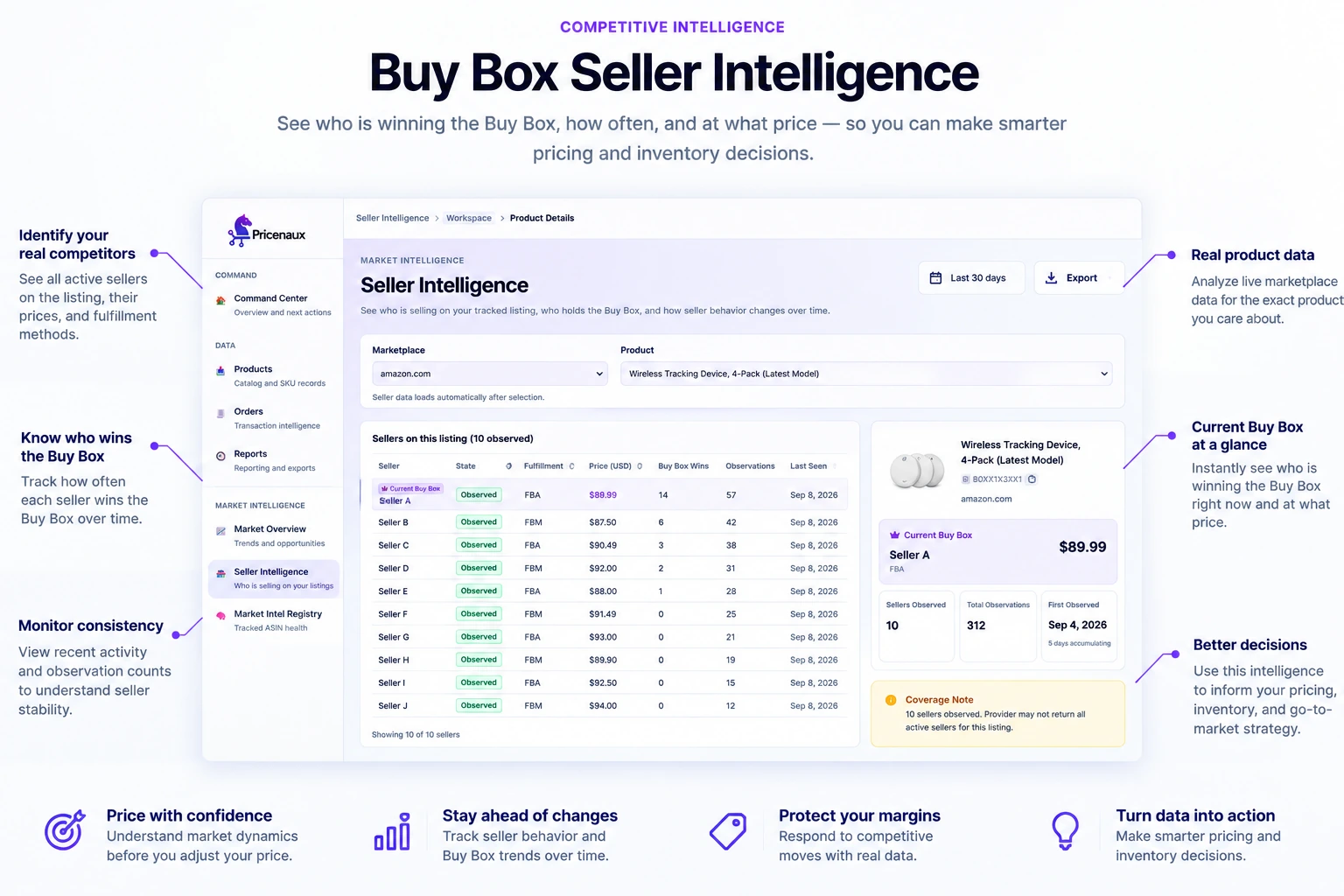
Pricenaux goes beyond monitoring a single competitor price. Buy Box Seller Intelligence builds a seller-level view of a tracked Amazon listing so merchants can understand which sellers appear repeatedly, how their observed prices compare, what fulfillment methods they use, who is currently observed holding the Buy Box, and how seller activity changes over time.
Anonymized example based on real Pricenaux observations.
Identify Relevant Competitors
See which sellers repeatedly appear on the same listing, compare observed offer prices, review available FBA or FBM fulfillment context, and understand how consistently each seller is being observed.
Track Buy Box Activity
See the current observed Buy Box holder and accumulated Buy Box wins across the monitored period to better understand which sellers appear to be competing most consistently for the listing.
Know Exactly Where You Stand
If you sell the tracked product, add your Seller ID to identify your own offer within the seller landscape and compare your price, fulfillment method, and observed Buy Box position against other observed sellers.
Look beyond individual sellers to the category environment.
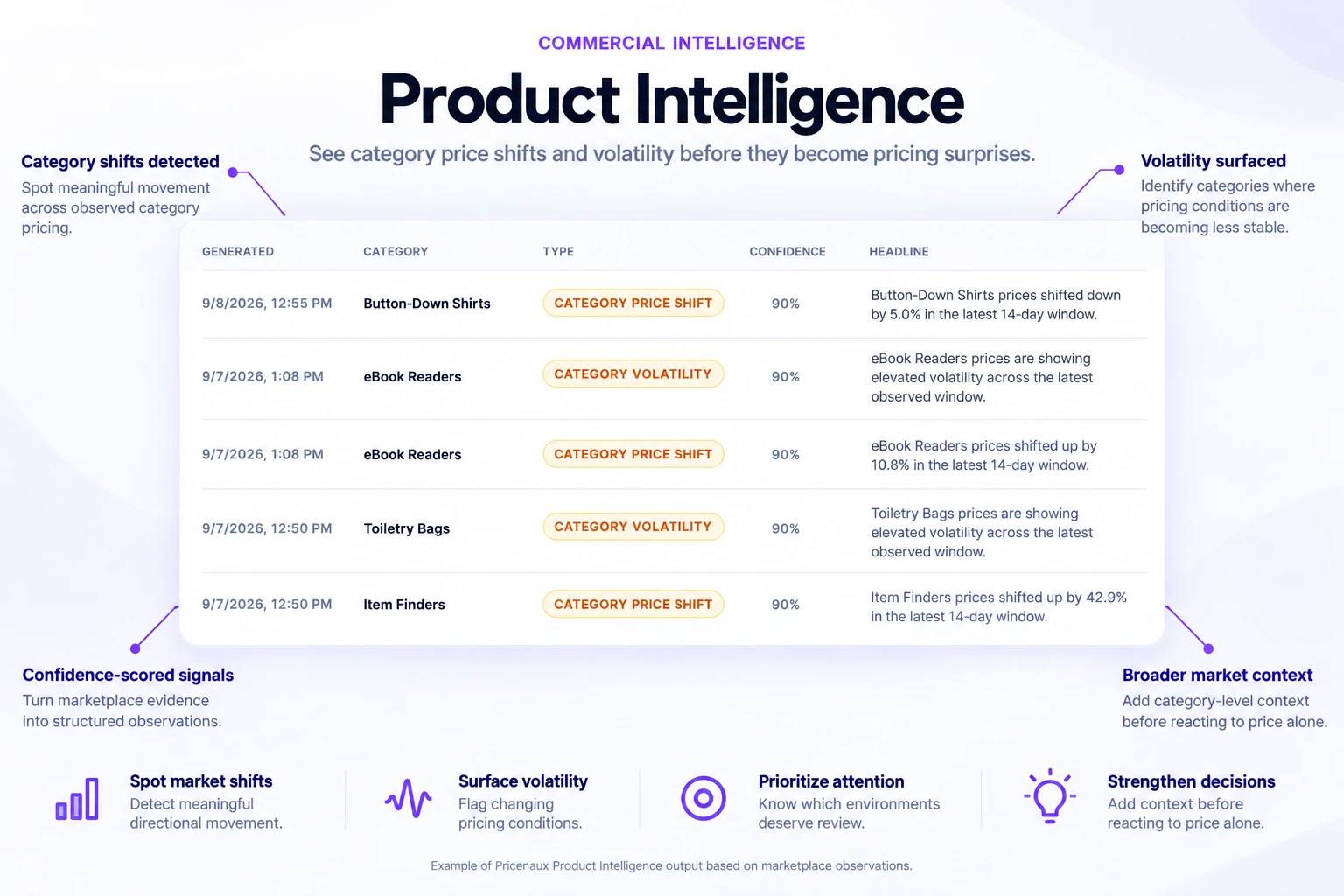
Knowing who is competing for the Buy Box explains only part of the Amazon pricing environment. Pricenaux Product Intelligence adds category-level observations that help sellers understand whether broader pricing conditions around a product may be shifting.
Product Intelligence can surface patterns such as category price movement and elevated volatility, giving merchants additional context when interpreting competitor behavior. A seller price change may be isolated; similar movement across a broader category can tell a very different story.
From product and marketplace evidence to a pricing decision.
Pricenaux brings internal product evidence and external market signals into one explainable decision workflow.
Different Amazon products can need different pricing workflows.
The same seller may have mature products, highly contested listings, new launches, and long-tail catalog items at the same time. Pricenaux allows the pricing approach to reflect those differences.
Mature Products
Use product-based recommendations when historical performance and demand evidence are meaningful.
Competitive Listings
Use market-based intelligence when competitor movement, seller activity, and marketplace pressure need closer interpretation.
New & Low-Data Products
Use Launch Pricing when sufficient product history does not yet exist.
Larger Catalogs
Apply product-level pricing intelligence across many SKUs while preserving differences in demand, margin, lifecycle stage, and competitive position.
Explore Multi-SKU Pricing IntelligenceCompeting does not have to mean racing to the bottom.
Amazon sellers operate in highly visible markets, but the lowest observable price is not automatically the right commercial decision. Pricenaux helps evaluate demand, performance, margin, positioning, and market pressure together.
One product. Two kinds of evidence. One commercial decision.
Consider a synthetic example of an established premium coffee grinder sold on Amazon. The product has meaningful order history and healthy demand, while a relevant competitor has recently reduced price and marketplace seller activity has changed.
Product Evidence
Historical product performance, order behavior, demand sensitivity, margin considerations, and the seller's commercial objective.
Marketplace Evidence
Competitor price movement, observed seller activity, Buy Box context, competitive positioning, and broader market pressure.
Pricenaux Decision Support
An explainable recommended price and practical range, supported by confidence and rationale, with the option to move, partially respond, hold, wait, or reposition depending on the evidence.
Want a clearer pricing starting point?
Pricenaux's Free Pricing Audit gives sellers a practical way to review their current pricing posture and identify areas that may deserve closer attention before making a pricing change.
Use the audit as a starting point before deciding what pricing action, if any, should come next.
Your Amazon marketplace may be only one part of the business.
Many merchants sell the same or related products across Amazon and Shopify. Those channels can produce different demand, pricing, competitive, and margin signals even when the underlying product is the same.
More than one pricing tool for more than one pricing situation.
Market Intelligence
Understand competitor movement, market pressure, competitive position, and available seller context around relevant products.
Explore Market IntelligenceDynamic Pricing
Use product performance and market evidence to develop explainable pricing recommendations with seller control.
Explore Dynamic PricingLaunch Pricing
Establish a market-informed starting price for new or low-data products before substantial sales history exists.
Explore Launch PricingProduct Market Health Score
Evaluate broader product-market conditions through a connected view of performance, competition, pressure, and risk.
Explore Product Market HealthBuilt for Amazon sellers in the U.S. and Canada.
Pricenaux supports Amazon pricing and commercial intelligence workflows for sellers operating in the United States and Canada. Public subscription pricing is presented in USD.
Amazon Pricing Intelligence FAQ
Amazon pricing intelligence combines product performance, demand sensitivity, margin considerations, competitor pricing, seller activity, Buy Box signals, and market context to help sellers make more informed pricing decisions.
Yes. When a product has meaningful historical performance, Amazon sellers can use order history, product performance, demand sensitivity, margin considerations, and commercial objectives to develop an explainable pricing recommendation without making competitor pricing the primary input.
Product-based pricing focuses primarily on the seller's own product performance, order history, demand sensitivity, margin considerations, and commercial objective. Market-based pricing adds external evidence such as competitor movement, observed seller activity, Buy Box signals, competitive position, and marketplace pressure.
No. A competitor price change is treated as a signal rather than an instruction. Depending on the evidence and commercial objective, a seller may choose to match, partially move, hold, wait, or reposition.
Buy Box Seller Intelligence adds available seller and Buy Box-related observations to the broader pricing picture so sellers can consider marketplace activity alongside competitor pricing, product performance, margin, and commercial objectives.
Seller coverage depends on available marketplace data and may not include every active seller.
Yes. Pricenaux helps sellers evaluate pricing through demand, product performance, margin considerations, competitive position, and market context together rather than defaulting to discounts or competitor matching.
Yes. Launch Pricing helps sellers establish a market-informed starting price for new or low-data Amazon products before meaningful product-level sales history exists.
Yes. Pricenaux can support pricing intelligence across larger product catalogs while preserving product-level differences in demand, performance, margin, competitive conditions, lifecycle stage, and commercial positioning.
Pricenaux can help merchants consider Amazon marketplace evidence alongside Shopify product performance so pricing decisions across channels can be evaluated with broader commercial awareness rather than as isolated events.
Make Amazon pricing decisions with more than one signal.
Bring together product performance, demand sensitivity, margin considerations, competitor movement, seller activity, Buy Box context, and market intelligence in an explainable pricing workflow.