
01
Different Competitors
Each product can face a different competitive set, price structure, and level of market pressure.
Different products behave differently. Your pricing intelligence should too.
Managing dozens, hundreds, or more products creates a different pricing challenge. Each SKU can face different competitors, demand patterns, product performance, market pressure, positioning, and margin requirements.
Pricenaux helps multi-SKU and multi-brand teams bring those product-level signals into a more structured pricing-intelligence workflow — so portfolio complexity does not force every product into the same pricing rule.
A multi-SKU portfolio is not one market. Products can have different competitors, demand sensitivity, sales velocity, strategic roles, margin structures, positioning, and levels of competitive pressure.
Each product can face a different competitive set, price structure, and level of market pressure.
Some products may be highly price-sensitive while others can support stronger pricing without the same demand response.
Revenue, units, profit, order history, and product momentum can vary significantly across the same portfolio.
A traffic-driving SKU, premium product, new launch, and margin contributor should not automatically receive identical pricing treatment.
Scaling pricing decisions should not mean flattening product differences.
Pricing guardrails and operating rules help teams stay disciplined, but applying the same response across every SKU can ignore the differences that make each product economically and competitively distinct.
A competitor price drop may justify action for one product and no action for another. A margin target that works for a mature bestseller may not fit a launch product. A high-pressure category may require a different response from a stable niche.
Pricenaux adds product-level intelligence around portfolio-wide controls so teams can maintain strategic consistency without assuming every SKU should behave the same way.
Pricenaux organizes pricing intelligence around individual products while giving teams a broader view of how those products behave within their competitive environments.
Monitor selected competitors, market movement, competitive intensity, and relevant marketplace context around individual SKUs and ASINs.
Interpret product position and market conditions rather than assuming every competitor move requires the same response.
Use available historical and performance data to understand how price may relate to product demand and purchasing behavior.
Evaluate revenue, units, profit, historical orders, and other performance signals where the relevant product data is available.
Incorporate positioning, pricing objectives, margin requirements, and configured guardrails into the decision.
Turn the available evidence into pricing guidance that can include a recommended price or range, confidence, and supporting reasoning.
As catalogs grow, the challenge shifts from seeing individual price changes to understanding which products deserve closer attention and why.
Pricenaux Market Intelligence helps teams monitor products over time, interpret market pressure, track competitor movement, and use product-level signals such as the Product Market Health Score to understand changing conditions across monitored products.
That creates a stronger basis for focusing analyst attention on products where market conditions, product strength, performance, or competitive behavior may justify review.
Explore Market IntelligenceFor monitored Amazon listings, seller coverage depends on available marketplace data and may not include every active seller.
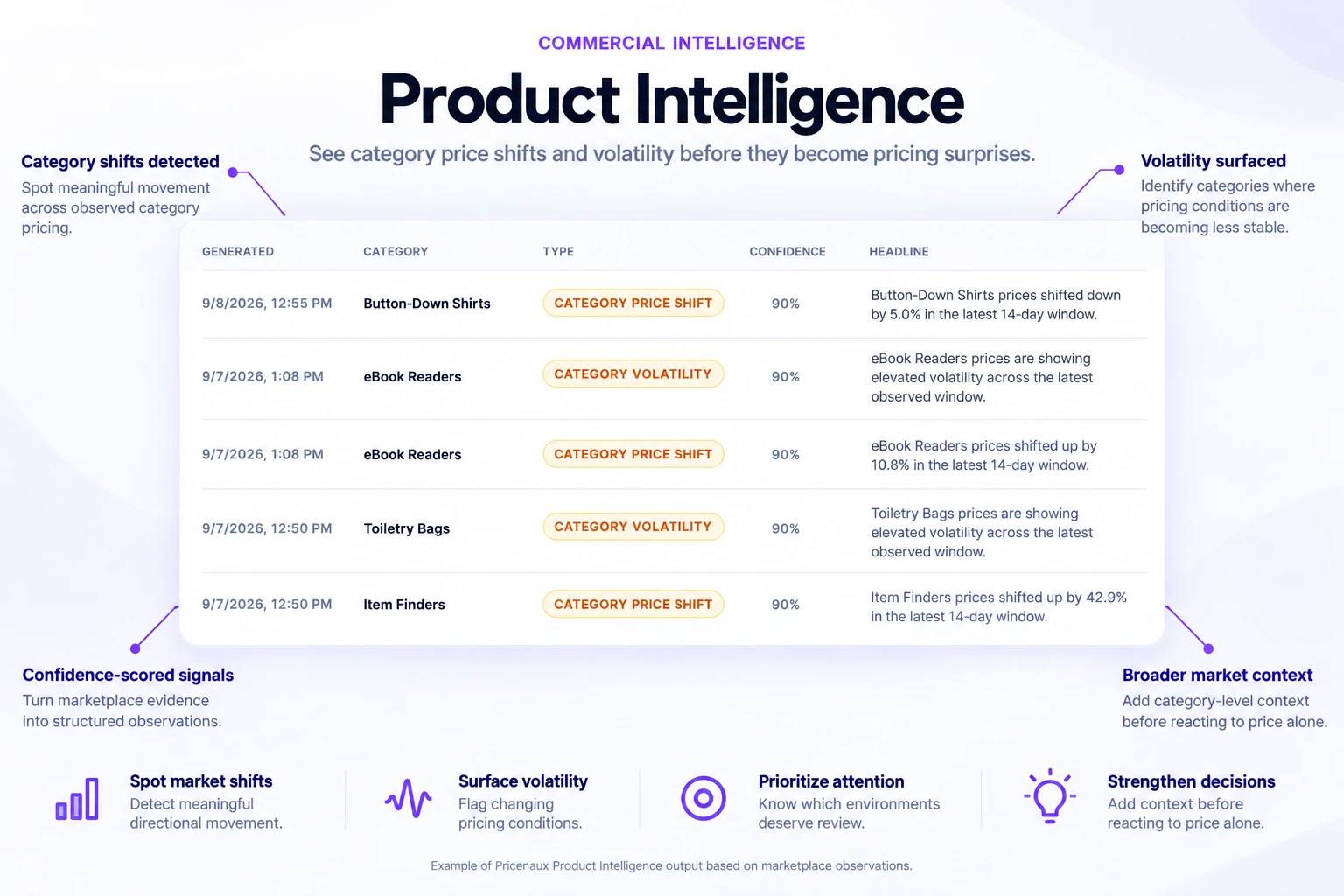
A large catalog does not mean every product requires the same level of attention at the same time. Pricenaux Product Intelligence adds category-level pricing observations that can help teams identify where broader market conditions may be changing across the environments surrounding their portfolio.
Signals such as category price shifts and elevated volatility provide another layer of context for prioritization. They can help teams investigate products operating in changing environments rather than reviewing every SKU with equal urgency.
Pricenaux supports both market-driven and product-performance-driven pricing analysis across supported Amazon and Shopify workflows. The useful evidence depends on the product, available data, and pricing objective.
Multi-brand teams often need common governance across the organization while preserving different positioning, pricing objectives, and competitive responses across brands and product lines.
Pricenaux helps centralize the intelligence layer while keeping pricing decisions grounded in the context of the individual product. For specialized portfolio structures, client-specific requirements, or bespoke workflows, Custom Intelligence can extend that approach further.
Explore Custom IntelligenceAutomation can help teams manage larger portfolios, but the quality of automation depends on the intelligence and constraints that come before execution.
Evaluate the relevant market, product, demand, performance, and business signals around the SKU.
Apply pricing guardrails, margin considerations, business objectives, and strategic controls.
Keep pricing human-approved where desired or use optional automated execution within configured controls.
The goal is not to automate every SKU identically. It is to make disciplined pricing easier to manage across more products.
Imagine three products in the same retail portfolio. A single portfolio-wide pricing rule could produce the same reaction across all three. Product-level intelligence can lead to different conclusions.
Several selected competitors have moved lower and product strength is weakening. A partial price move may be justified within margin guardrails.
A competitor discounts, but the product continues to perform well and positioning remains strong. Holding price may protect margin without sacrificing the objective.
Competitors are stable, but product performance and demand behavior have shifted. The pricing decision may need to respond to the product's own economics rather than competitor movement.
Portfolio intelligence is valuable because the same market event does not have to produce the same pricing response everywhere.
Teams managing multiple brands, product lines, positioning strategies, and competitive environments.
Merchants that need product-level context across a growing catalog rather than periodic manual review of every SKU.
Analysts and commercial teams that need explainable recommendations, guardrails, and clearer prioritization across products.
Sellers managing multiple ASINs, competitive sets, marketplace conditions, and observed seller context where available.
Brands managing SKU-level demand, product performance, margin, order history, and competitive positioning.
Teams supporting multiple stores, portfolios, clients, or pricing strategies that may require more customized intelligence workflows.
Multi-SKU complexity is not only about how many products a retailer manages. The same portfolio can also face different pricing evidence across Shopify, Amazon, or both. Pricenaux helps merchants preserve those differences while maintaining a connected pricing-intelligence approach.
Use order history, SKU performance, demand sensitivity, margin considerations, and first-party commercial evidence to support product-level pricing decisions.
Explore Shopify Pricing IntelligenceCombine product-performance evidence with competitor movement, observed seller activity, Buy Box context, and marketplace pressure when those signals matter to the decision.
Explore Amazon Pricing IntelligenceConnect storefront and marketplace evidence without assuming the same product should always receive the same pricing action across channels.
Explore Multichannel Pricing IntelligenceMulti-SKU intelligence is not a separate engine. It brings together the same Market Intelligence, Dynamic Pricing, margin-protective logic, explainability, and strategic controls across a more complex product environment.
Monitor competitors, market pressure, product strength, Product Market Health Score, and relevant marketplace context.
Explore Market IntelligenceEvaluate whether a pricing move is justified before unnecessarily surrendering margin across the portfolio.
Explore Margin-Protective PricingSee why product-level context matters when pricing decisions extend beyond configured rule execution.
See the ComparisonPricenaux helps Amazon sellers, Shopify brands, and multi-brand retail teams connect product, market, demand, performance, and profitability signals across more complex pricing environments.
Multi-SKU pricing intelligence helps teams evaluate pricing conditions at the individual product level while managing a broader portfolio. It connects product-specific market, demand, performance, profitability, positioning, and business context rather than assuming every SKU should follow the same pricing response.
Products can face different competitors, demand sensitivity, sales performance, margin requirements, market pressure, and positioning objectives. Shared guardrails can create consistency, but product-level context helps determine whether the same pricing action is appropriate for every SKU.
Yes. Multi-brand retailers can use Pricenaux to centralize pricing intelligence, apply consistent guardrails, monitor competitive categories, preserve brand-specific positioning, and align pricing decisions across multiple product lines.
Yes. Amazon and Shopify workflows can use Market Intelligence, Market-Driven Dynamic Pricing, Product Performance-Driven Dynamic Pricing, Launch Pricing, demand-sensitivity analysis, and margin-protective recommendations depending on the product and available data. Buy Box Seller Intelligence is specific to monitored Amazon listings.
Product Market Health Score provides a product-level signal that can help teams understand changing market conditions across monitored products. Combined with competitor movement, product strength, market pressure, and performance signals, it can help identify products that may deserve closer pricing review.
Yes. Pricenaux supports market-driven and product-performance-driven pricing analysis. Depending on the workflow and available data, that can include competitor movement, market structure, demand sensitivity, order history, revenue, units sold, profit, product performance, and other commercial signals.
No. Pricenaux supports human-approved pricing decisions as well as optional automated execution within configured guardrails. Teams can choose the level of automation appropriate to their portfolio and operating model.
Catalog-wide rules can provide useful consistency, but multi-SKU pricing intelligence adds product-level interpretation around those controls. This allows teams to consider different market conditions, demand patterns, performance, profitability, and positioning before deciding whether the same pricing response makes sense across products.