
 Nermin Sad · CEO & Co-founder
Discover how mature your pricing process is — and where revenue or margin may be quietly leaking — with the Pricenaux Free Pricing Audit.
Ask a merchant what last month’s revenue was, and you will get a number in seconds.
Ask what their pricing approach is costing them, and the room often goes quiet.
Pricing is one of the most powerful commercial levers available to an e-commerce business. It influences revenue, demand, profitability, competitive position, customer perception, and how quickly inventory moves.
Yet for many Shopify merchants, Amazon sellers, and multi-SKU retailers, pricing remains one of the least structured parts of the business.
Prices may be reviewed once a month. Competitors may be checked manually. Margins may live in a spreadsheet. Changes may happen only after sales decline, costs rise, or a competitor moves first.
The business is making pricing decisions — but it may not have a pricing system.
And that difference is where revenue and margin can quietly disappear.
Pricing leakage is hard to see
The loud problems are easy to notice:
A sudden decline in sales
Pricing leakage is usually quieter.
It happens when a product remains priced too high and gradually loses demand.
It happens when a product remains priced too low, continues selling, and gives away margin the business may not have needed to sacrifice.
It happens when a merchant follows every competitor price cut without knowing whether the competitor is profitable, clearing inventory, temporarily discounting, or pursuing a different strategic objective.
It also happens when a cost increase is passed directly to customers without first determining which products can absorb the increase and which products face strong substitution risk.
Any one of these decisions may appear small.
Across dozens, hundreds, or thousands of SKUs, the combined effect can become commercially significant.
The real problem usually is not the price
When product performance weakens, the first instinct is often to blame the price.
Sometimes that is correct.
More often, the deeper problem is the process behind the decision.
Picture two merchants seeing the same competitor reduce the price of the same product.
The reactive merchant follows immediately.
The pricing-intelligent merchant asks:
Is the competitor’s move temporary or permanent?
Same signal.
Only one merchant knows what the signal means.
That is the difference between reacting to the market and making a commercial decision.
Five signs your pricing is too reactive
1. Competitors decide when you change prices
Competitor data should inform your strategy, not become the strategy itself.
Following every competitor move can trigger price wars, weaken positioning, and reduce margin without creating sustainable demand.
2. Your margins are calculated manually
Spreadsheets can work well during the early stages of a business.
But as catalog size, selling channels, costs, promotions, and competitive activity grow, manual processes become harder to maintain. Important changes can be missed, and pricing errors can hide between review cycles.
3. Prices only move on a schedule
Monthly or quarterly reviews may be appropriate for some products.
For others, waiting several weeks to respond to a meaningful cost, demand, inventory, or competitor signal can create avoidable leakage.
4. Decisions depend heavily on intuition
Experience is valuable.
It becomes more powerful when it is supported by product performance, margin requirements, competitive intelligence, demand signals, and a clear view of the downside.
5. You cannot explain why a price changed
“Raise the price” is not a complete recommendation.
A strong pricing recommendation should explain the inputs, the commercial logic, the expected impact, the risks, and the confidence behind the decision — so the human decision-maker remains in control.
If three or more of these signs feel familiar, you may not be pricing badly.
You may be pricing reactively.
There is a difference, and it can be fixed.
The Pricenaux Free Pricing Audit
We created the Pricenaux Free Pricing Audit to help merchants understand where their current pricing process stands.
The audit asks nine focused questions about:
Selling channels
It takes approximately four minutes.
Participants receive:
A personalized pricing maturity score
There is no credit card requirement, no login requirement, and no obligation to schedule a demo.
It is designed as a commercial diagnostic — not simply another lead-generation form.

Discover how the Pricenaux Free Pricing Audit helps Shopify merchants, Amazon sellers, and multi-SKU retailers assess pricing maturity, identify potential revenue leakage, receive personalized recommendations, and take practical action.
What the audit can reveal
Consider an anonymized profile based on a real Pricenaux Free Pricing Audit response.
The merchant sells through both Shopify and Amazon, manages between 50 and 500 SKUs, reviews prices monthly, tracks margins in a spreadsheet, monitors competitors manually, and is now facing unexpected cost increases.
The audit assessed this merchant at Level 2 of 3: Pricing Development.
Based on the audit’s diagnostic model, the merchant also received an estimated potential pricing-leakage range of 8–15%.
Important note: This is a directional diagnostic estimate, not a guarantee of recoverable revenue. Actual impact depends on product economics, demand, competition, costs, brand strength, and execution.
The first message to the merchant was not that their pricing process was reckless.
It was that they were already more disciplined than many merchants facing the same pressure.
They had built the habit of tracking margins and monitoring competitors, even without a formal system forcing them to do so.
That discipline matters.
The problem was that the business was still responding after market changes occurred instead of using defined thresholds and decision rules to act earlier.
You are not reckless with pricing. You are disciplined — but one step behind, and one step behind can be expensive.
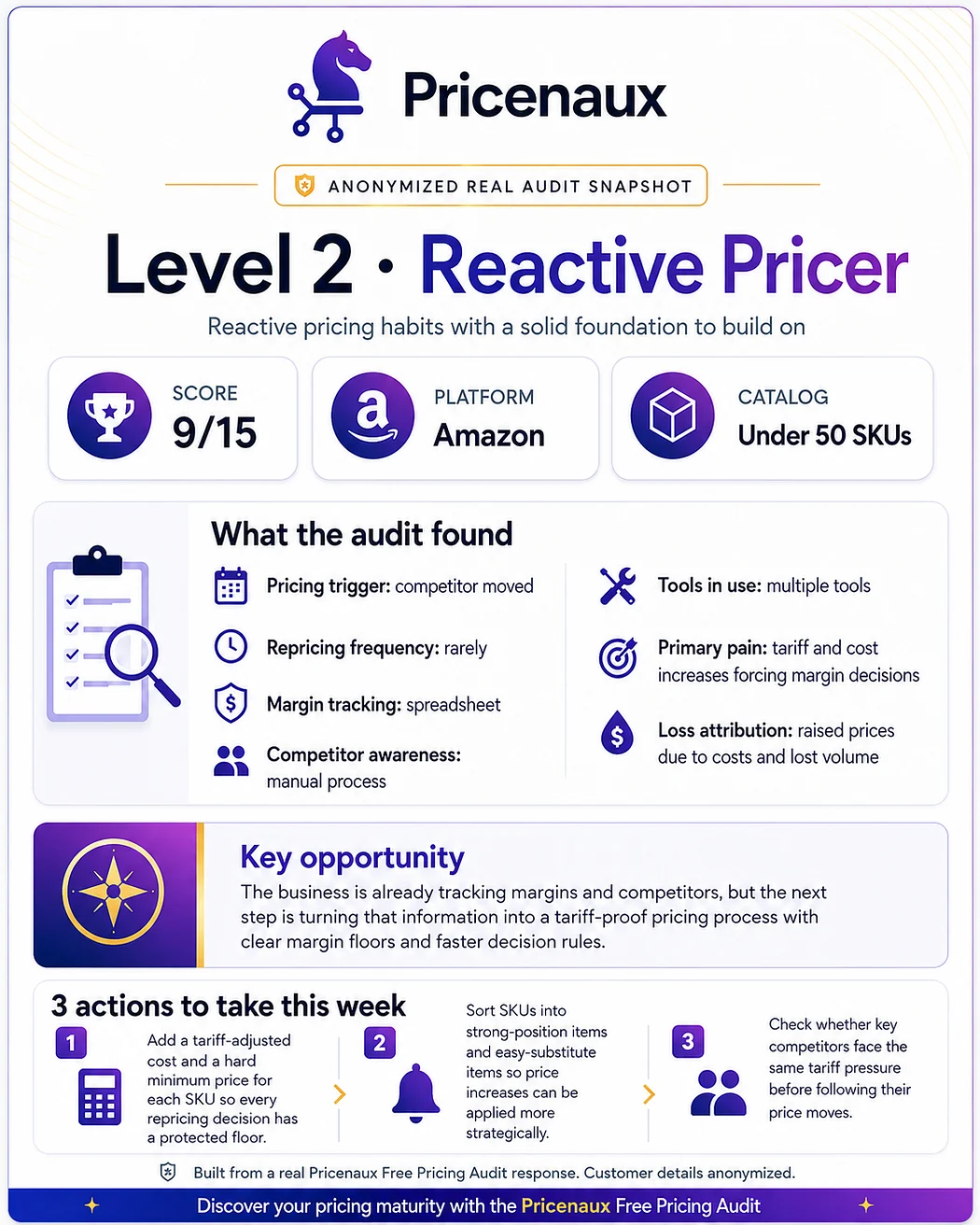
An anonymized real Pricenaux Free Pricing Audit showing how an Amazon merchant with a small catalog can move from reactive pricing toward clearer margin floors, stronger decision rules, and more confident responses to cost and competitor pressure.
The audit then recommended three practical actions.
1. Set a real price floor
Add one new column to the existing spreadsheet: the minimum acceptable price for each affected SKU.
This floor should reflect landed cost and the merchant’s target margin.
The purpose is not to create a perfect model overnight.
It is to establish a defensible limit below which the business will not follow a competitor automatically.
2. Segment products before reacting
Separate affected SKUs into two groups.
The first group includes products with fewer close substitutes, stronger differentiation, or more customer loyalty. These products may have more room to absorb a price increase, depending on demand sensitivity and the surrounding commercial context.
The second group includes products with nearly identical alternatives. These may require a different response, such as bundling, substitution, repositioning, or a deliberate margin concession chosen by the business rather than one imposed by the market.
3. Watch the category, not only one competitor
A single competitor price move does not always explain what is happening.
If several competitors face the same cost pressure, the entire category may be preparing to reprice.
In that situation, a merchant that acts with evidence and confidence may be able to establish a new market anchor rather than reacting late.
None of these actions requires Pricenaux software.
They require a clearer diagnosis of the current pricing process.
That is the purpose of the audit.
From pricing analytics to commercial intelligence
The audit is the starting point.
It diagnoses how mature the current pricing process is and identifies the areas that deserve attention first.
Commercial intelligence is the next stage.
Traditional pricing analysis usually explains what has already happened.
Commercial intelligence asks broader questions:
What is happening now?
Pricing rarely operates in isolation.
One pricing decision can involve product costs, demand, customer sensitivity, inventory, competitor behaviour, marketplace conditions, brand position, channel strategy, and business objectives.
Pricenaux is being built to connect those signals and translate them into decisions that merchants can understand, evaluate, and defend.
The goal is not simply to automate price changes.
The goal is to help businesses move from reactive repricing to explainable, systematic, and commercially informed decision-making.
Start with a diagnosis
Before buying a new pricing tool or redesigning an entire strategy, a business needs to understand where it currently stands.
Ask:
Are pricing decisions based mainly on intuition?
A four-minute audit will not replace a complete pricing strategy.
But it can show what deserves attention first.
That is often the step that matters most.
Find out what your pricing approach may be costing you
Your pricing process may be further along than you think.
It may also contain gaps that are quietly affecting revenue, margin, and competitive performance.
The Pricenaux Free Pricing Audit helps you identify both.
In approximately four minutes, you receive:
A personalized pricing maturity score
No credit card.
No login.
No demo pressure.
Find out where your pricing process is strongest — and where revenue or margin may be quietly leaking.
Start the Free Pricing Audit →
Then tell us:
What currently triggers a price change in your business — gut feel, a competitor’s move, a defined rule, or a scheduled review?
The honest answer to that one question may reveal more about your pricing maturity than most merchants realize.
Have a perspective on this topic?
Continue the discussion with Pricenaux and other operators on LinkedIn.
Join the LinkedIn DiscussionHow mature is your pricing process?
Benchmark your pricing approach, identify decision gaps, and see where stronger guardrails or intelligence could protect margin.